
 USA (1941)
Prototype Heavy Bomber – 1 Built

The XB-19 was a heavy bomber designed in 1935 to fulfill a request made by the United States Army Air Corps (USAAC) to develop an experimental heavy bomber with extreme range. Although slow in its development and obsolete by the time it was produced, it served as a test vehicle to evaluate plane and engine performances. The sole XB-19 was converted to a cargo transport plane and was eventually scrapped in 1949. The XB-19 was the largest plane operated by the USAAC and USAAF until the Convair B-36 came into service.
History
The roots of the XB-19 can be traced to 1935 on February 5th when the United States Army Air Corps (USAAC) commenced “Project D”. The purpose of Project D was to experiment with the maximum distances achievable with bombers. The USAAC contacted and discussed the project with Douglas Aircraft Company and Sikorsky. Douglas representatives agreed to the terms of the design and plans were made during a conference on June 5th, 1935. The initial plan was to begin the basic design on July 31st of 1935, detailed designs on January 31st of 1936, and have the plane physically produced by March 31st, 1938. The plan however was soon found out to be too ambitious, with the designers underestimating the work required. The designers would be plagued with a lack of proper funding and the sheer enormity of the task. The project would finally be completed in May of 1941, nearly four years after the original deadline.

Douglas Aircraft Company received a contract to the project in October of 1935 which required Douglas to create a general and detailed design of the plane, create a mockup of the plane and test the wing centre section, undercarriage, and engine nacelles of the plane. Douglas accepted the contract on October 18th. Later that year, the USAAC would evaluate the mockups provided by Douglas and Sikorsky. Douglas’s design was ultimately chosen, and was given the task of further developing the plane.

The plane would be known as the “XBLR-2” (Experimental Bomber Long Range 2) in its early stages of development. The progress of developing the bomber proved to be tedious and slow. Lack of funding would severely hinder work on the plane. During that time the USAAC made a change to the requirements, the plane was suppose to be powered by four Allison XV-3420-1 engines producing 1,600 horsepower each, but was ordered to be replaced by four Wright R-3350 engines producing 2,000 horsepower each instead. This would also hinder work as the plane had to be slightly redesigned. As time went on, Douglas had to loan a Douglas OA-4A from the USAAC to test an experimental tricycle landing gear configuration intended for the XBLR-2. The tests proved to be a success. Later, the XBLR-2 would be redesignated as “XB-19” (Experimental Bomber 19). Douglas eventually managed to scrape together enough funds to produce a prototype, and the production was authorized on March 8th of 1938.


During its development, the Douglas company had many problems with the XB-19. They were forced to allocate more funds than initially expected, and needed design staff to work on other aircraft which had a more promising production future. They claimed the XB-19’s design was obsolete due to the production delays it suffered over the past three years and the fact that the plane’s weight was far heavier than expected. The Douglas company officially made a recommendation to cancel the XB-19 project on August 30th, 1938. This recommendation was denied by the USAAC. Interestingly enough, two years later, the USAAC would suggest that the slow development of the XB-19 already rendered the project obsolete when they removed the plane from the top secret classified list. The XB-19 would finally be completed in May of 1941.

Shortly after completion, the XB-19 was used in taxiing tests on May 6th, 1941. The flight test was scheduled to be on May 17th, but was postponed three times due to critical mechanical errors. The landing gear brakes were found to have defects, its engines had backfiring issues, and the propeller pitch control system had to be worked on. On June 27th however, the XB-19 would finally have its maiden flight. In the maiden flight, seven crewmembers were on board with Major Stanley M. Umstead in charge. The flight lasted 55 minutes from Clover Field in Santa Monica to March Field. The flight went by smoothly without any problems and was successful. Shortly afterwards, Donald Douglas would receive a congratulatory telegram from President Roosevelt. The USAAC unofficially accepted the XB-19 in October of 1941.

After the Japanese attack on Pearl Harbour on December 7th of 1941, the United States was on high alert. The XB-19’s turrets were armed and a new layer of olive camouflage paint was applied, replacing its bare metal USAAC livery. It would make 4 more tests flights in California before being transferred to Wright Field on January 23rd, 1942 as another safety measure. By then, the XB-19 had over 70 hours of flight time.
The XB-19 was finally accepted officially by the USAAF in June of 1942 after minor modifications were made to the plane’s brake system. The contract cost to the United States government was $1,400,064. The Douglas Aircraft Company also spent $4,000,000 in personal company funds. The XB-19 was extensively tested by the USAAF for eighteen months to see the engine performances and different altitudes and the maneuverability of the aircraft. The results of these tests would later go on to influence the design of the Boeing B-29 Superfortress and the Convair B-36. The XB-19 performed well in all aspects and was generally free of problems. The only problem noted however was the inefficient engine cooling process. Due to this, the cooling gills on the plane had to be open the whole time in longer flights, thus reducing the effective speed of the XB-19.

After the XB-19 was thoroughly tested and experimented with, the USAAF no longer had a need for it. It was brought to the Wright Field and modified to be a cargo transport aircraft. It was refitted with Allison V-3420-11 engines and had its armaments removed. The new aircraft would be designated “XB-19A”. For the next two and a half years, the XB-19A would fly to numerous airfields within Ohio. It was documented to have been stationed at Wright Field, Patterson Field, Lockbourne Air Base, and Clinton Country Air Base. The XB-19A would make its last flight on August 17th, 1946, where it flew to the Davis-Monthan airfield in Arizona from Wright Field to be stored. It stayed in storage for three years before finally being scrapped in 1949, thus ending the legacy of the XB-19.

To this day, only two wheels of the XB-19’s landing gear survives. One can be seen in the Hill Aerospace Museum in Oregon, and the other can be seen in the National Museum of the United States Air Force in Ohio.

Design
The XB-19 is described as a colossal, all metal low wing monoplane installed with a conventional tricycle landing gear. The two main wheels of the landing gears measured at 2.44 m (8 ft) in diameter, which was impressive for the time. The original design specifications ordered wanted the engines to be four Allison XV-3420-1, but was swapped for four Wright R-3350-5 engines instead with a three blade metal propeller with a 5.18 m (17 ft) diameter. The engines would be switched once again to Allison V-3420-11 after the plane was repurposed as a cargo transport aircraft. The plane could carry an impressive amount of fuel, at 38,178 L (10,350 US Gallons) in its auxiliary fuel tanks, with an optional 3,210 L (824 US Gallons) that could be stored in the bomb bay.

The XB-19 carried 8,480 kg (18,700 lbs) of ordinance usually, but could be overloaded to 16,828 kg (37,100 lbs) if fuel was reduced significantly. As for armaments, the initial prototype was unarmed. Later though, two 37mm Oldsmobile T9 autocannons, five 12.7mm M2 Brownings and six M1919 Brownings were fitted to the plane. One T9 was fitted to the nose while the other was fitted to the upper front turret, each accompanied by a single M1919 machine gun. There would be one M1919 on each side of the bombardier’s position, and a M1919 on each side of the stabilizer. A single M2 Browning was fitted in the tail of the XB-19, two M2 Brownings on each side of the galley compartment, one in the bottom turret, and one in the upper powered turret.
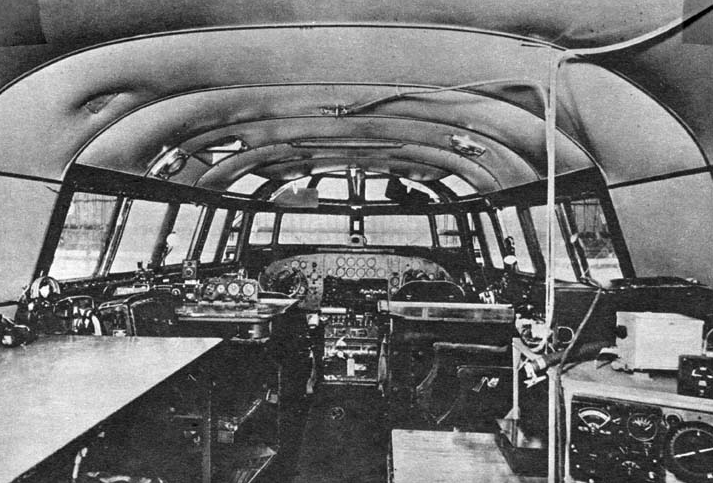
In the crew compartment, there was eight seats and six bunks. The compartment could accommodate two flight engineers, and six relief crew members. The normal combat crew consisted of sixteen people. (Refer to Specifications Table).
Variants
- XB-19 – The original model and design. Initially developed as a long range heavy bomber for the USAAC, but was outdated by the time it entered service. It served as a “flying laboratory”, testing engine performances and plane handling. It was converted to the XB-19A after the USAAF no longer had use for it.
- XB-19A – The XB-19A was a converted XB-19 using improved Allison V-3420-11 engines. It was used as a cargo transport aircraft after the air force was done experimenting with it. All armaments were removed. It was scrapped in 1949.
Operators
- United States of America – The XB-19 and XB-19A was operated by the USAAC and USAAF throughout its service life.
Douglas XB-19 |
|
| Wingspan | 212 ft / 64.62 m |
| Length | 132 ft & 4 in / 40.34 m |
| Height | 42 ft / 12.8 m |
| Wing Area | 4,285 ft² / 398.091m² |
| Wing Loading | 32.6 lb/sq ft / 159.5 kg/sq m |
| Power Loading | 17.5 lb/hp / 7.9 kg/hp |
| Engine | 4x Wright R-3350-5 Duplex Cyclone (2,000 hp) |
| Fuel Capacity | 10,350 US Gallons / 38,178 L – in auxiliary fuel tanks + 824 US Gallons / 3,120 L – in bombay (Optional) |
| Maximum Weight | 140,000 lbs / 63,503 kg |
| Empty Weight | 86,000 lbs / 39,009 kg |
| Climb Rate | 650 ft/min / 198 m/min |
| Speeds | Cruising: 135 mph / 217 km/h – Sea Level
Operational: 186 mph / 299 km/h – @ 15,700 ft / 4,785 m Maximum Speed: 224 mph / 360 km/h – @ 15,700 ft / 4,785 m |
| Normal Range | 5,200 mi / 8,369 km |
| Maximum Range | 7,710 mi / 12,408 km |
| Service Ceiling | 23,000 ft / 7,010 m |
| Crew | 2x Pilots
1x Commander 1x Navigator 1x Engineer 1x Radio Operator 1x Bombardier 2x Flight Mechanics 1x Turret Operator 8x Gunners 6x Relief Crew (24 Crew – 16 Active, 2 Emergency Stations, 6 Relief Crew) |
| Defensive Armament | 2x 37mm Oldsmobile T9 Autocannon
5x 12.7mm M2 Browning 6x 7.62mm M1919 Browning |
| Normal Ordinance | 18,700 lbs / 8,480 kg |
| Maximum Ordinance | 37,100 lbs / 16,828 kg *
* – with reduced fuel load |
Douglas XB-19A |
|
| Wingspan | 212 ft / 64.62 m |
| Length | 132 ft 4 in / 40.34 m |
| Height | 42 ft / 12.8 m |
| Wing Area | 4,285 ft² / 398.091m² |
| Wing Loading | 32.71 lb/sq ft / 159.8 kg/sq m |
| Power Loading | 13.51 lb/hp / 6.1 kg/hp |
| Engine | 4x Allison V-3420-11 (2,600 hp) |
| Loaded Weight | 140,230 lbs / 63,607 kg |
| Empty Weight | 92,400 lbs / 41,912 kg |
| Maximum Speed | 265 mph / 426 km/h |
| Cruising Speed | 185 mph / 298 km/h |
| Normal Range | 4,200 mi / 6,759 km |
| Service Ceiling | 39,000 ft / 11,885 m |
Gallery


Sources
Bunker, Howard G. Development, Test and Acceptance of Douglas XB-19 Airplane, AAF No. 38-471. 1942, pp. 18–25, Development, Test and Acceptance of Douglas XB-19 Airplane, AAF No. 38-471., Francillon, René J. McDonnell Douglas aircraft since 1920. Putnam, 1988., Images: Side Profile Views by Ed Jackson – Artbyedo.com, Colorized Images by Michael of PE

 Empire of Japan (1945)


